
Risk Scenarios to be covered by a Disaster Recovery Plan
Every company must identify the risks it wishes to cover in a DRP context, which can include:
- Natural Disaster: Windstorm | Forest Fire | Earthquake | Flood
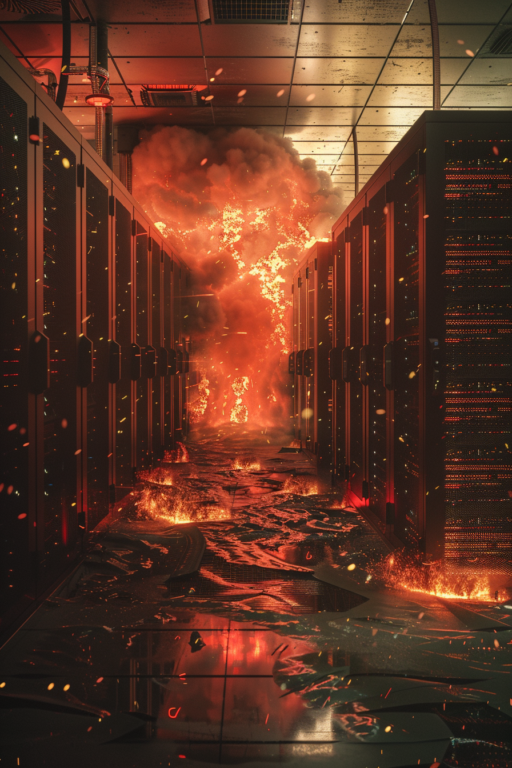
- Fire: Datacenter Fire, Building or Site Fire
- Utility Failure: Air Conditioning Stop | Datacenter Power Outage
- Human Crisis: State Terrorism Attack | Strike
- Cyber Attack: Phishing, ransomware, Ddos, …
- Complex IT Incident: Hypervisor failure
These risks will then be translated into risk scenarios for IT and business operations.
The concept of prolonged unavailability, characteristic of a DRP, differs from the concept of temporary unavailability, which is addressed by critical incident management of its high-availability information system architecture.
For each company, this boundary between temporary and prolonged unavailability can range from a few hours to a few days.
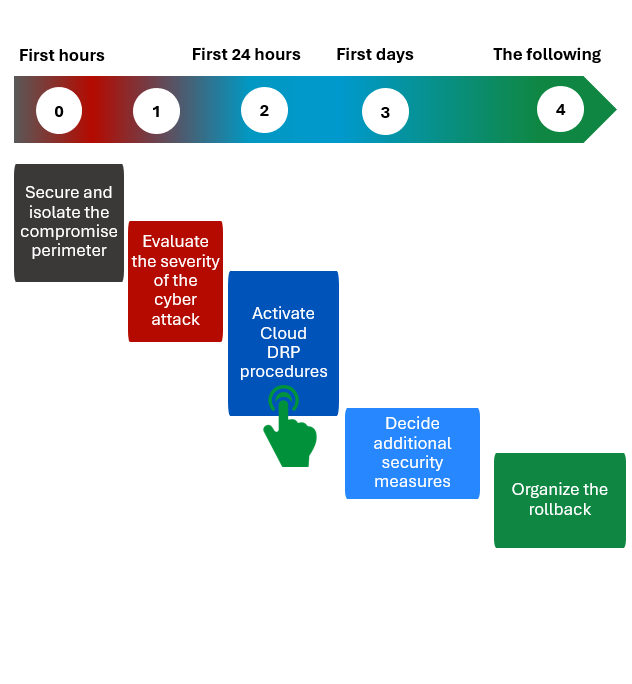
The objectives of operational crisis management of a cyber-origin crisis
Compared to other crisis scenarios that may require the activation of a DRP, cyber crises have their own characteristics:
- Immediate impacts (stopping of certain activities, inability to deliver services, etc.).
- Uncertainties regarding the scope of the compromise.
- Complexity in deciding what can be restarted in DRP mode or not, and in what order, this being related to:
- The vector of the attack: is it a ransomware commanded from the outside, …
- Potential propagation to other external organizations due to the interconnection of IT systems.
In the first few hours, it can be difficult to distinguish an IT incident from a cyber incident. Technical teams must attempt to detect weak signals to shut down systems if necessary.